
THE PROBLEM
EVERY NEW VENDOR IS AN ENGINEERING PROJECT, UNTIL IT ISN'T.
Lending platforms depend on third-party vendors. The common ones have pre-built connectors. The harder case is more specific: a particular lending service provider (LSP) or digital lending app (DLA) that originates for one product line, or a regional partner nobody else on the platform has connected to before. For an integration like that, the answer typically involves a queue: a new engineering ticket, a developer working through unfamiliar API documentation, and a build that competes with everything else on the roadmap.
Vendor documentation varies widely in structure and completeness. Getting an integration right on the first attempt usually depends on a small number of engineers who have done it before. That dependency is what turns a routine integration request into a multi-week wait, and it's often the hidden cost behind a "yes, we can support that vendor" answer during a platform evaluation.
🔀
VENDOR VARIABILITY
Every vendor structures its API differently. An approach that works for one LSP or payment gateway rarely transfers cleanly to the next.
📄
DOCUMENTATION GAPS
API references describe the vendor's system, not how it should wire into a specific lending workflow. That gap gets filled by trial and error.
🧠
EXPERTISE DEPENDENCY
Getting an integration right the first time usually depends on a small number of engineers who have done it before.
⏳
DELAYED GO-LIVES
A pending integration can hold up a new originating partner, a new payment partner, or an entire product launch.
HOW IT WORKS
FROM VENDOR DOCUMENTATION TO A LIVE INTEGRATION.
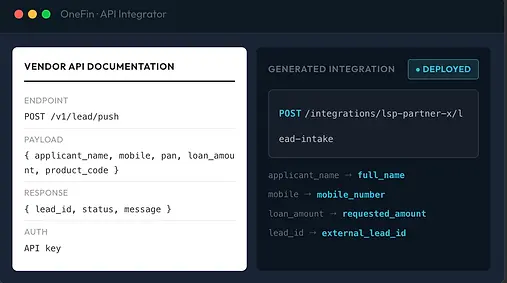
API Integrator turns a vendor's API documentation into a deployed, callable integration, with a reviewed path to production.
1
VENDOR DOCUMENTATION IS THE INPUT
The vendor's API documentation, endpoint URLs, payload structure, and response structure, is what the build starts from.
INPUT: API DOCS
2
THE API STRUCTURE IS MAPPED
The system reads the vendor's endpoints and payload and response formats, and maps how the API's flows and dependencies fit together.
AI-ASSISTED
3
A LIVE INTEGRATION IS BUILT AND DEPLOYED TO UAT
The result is a deployed, callable endpoint, not a code stub or a specification document. It is built directly into a UAT environment for testing.
UAT ONLY
4
REVIEWED, THEN PROMOTED TO PRODUCTION
Every generated integration is reviewed before release. The build capability itself has no write access to production; only a reviewed integration is promoted.
HUMAN REVIEW
BENEFITS
FASTER INTEGRATIONS, WITHOUT CUTTING THE REVIEW STEP.
API Integrator's biggest impact is on the time between deciding to support a vendor and actually having that vendor live in the workflow.
⚡
FASTER TURNAROUND
New vendors move from documentation to a working, deployed integration in a fraction of the time a manual, ground-up build takes.
🛠️
LESS ENGINEERING LOAD
Frees engineering capacity from repetitive, vendor-specific wiring work, so it can go toward product priorities instead.
📐
CONSISTENT DELIVERY
Every integration follows the same reviewed, production-gated path, regardless of which vendor or which engineer originally handled it.
🚀
FASTER GO-LIVES
New bureaus, payment partners, or product launches are no longer held back by an integration backlog.
KEY CAPABILITIES
WHAT THE SYSTEM DOES, AND HOW.
📄
STRUCTURED API DOC INGESTION
The build works directly from a vendor's endpoint URLs, payload structure, and response structure. No separate mapping specification needs to be prepared.
🔗
DEPLOYED, CALLABLE OUTPUT
The result is a working integration that is deployed and callable, not generated code that still needs to be wired up and deployed separately.
.webp)
PRODUCTION-GATED DEPLOYMENT
The build capability operates within UAT only and has no write access to production. A newly built integration reaches production only after review.
PLATFORM INTEGRATION
ONCE LIVE, INTEGRATIONS CONNECT DIRECTLY INTO YOUR LOS AND LMS.
🔗
SAME DATA LAYER, NO MIDDLEWARE TO MANAGE
A promoted integration connects directly into OneFin's LOS and LMS data layer. There is no separate middleware layer or export and import step to manage on the client side.
LOS
LMS
COLLECTION SYSTEM
ACCOUNTING SYSTEM
ALSO AVAILABLE
MANY INTEGRATIONS ARE ALREADY BUILT.
For a substantial set of vendors, there's no build to plan for at all. These are already integrated and ready to use.
Credit Bureaus
Banking Analysis
Anti-Fraud Tools
KYC Providers
SMS Gateways
70+
eNACH
eSign
Banking APIs
Payment Gateways
Accounting Systems
WHO IT'S FOR
RELEVANT WHEREVER VENDOR DEPENDENCIES SHAPE THE ROADMAP.
CTO / TECHNOLOGY
TECHNOLOGY LEADERS
Vendor lock-in and integration backlogs are common concerns when evaluating a lending platform. Fast, reviewed integration builds take most of that risk off the roadmap.
COO / Operations
OPERATIONS LEADERS
A new bureau, payment partner, or collections agency relationship doesn't have to wait behind an engineering queue. Product and partnership timelines can move independently of integration capacity.
CRO / RISK
RISK AND COMPLIANCE TEAMS
Every integration is reviewed before it reaches production. The build capability itself cannot deploy directly to a live environment.